Scandinavia Travel Guide: Everything You Need to Know Before You Go
Scandinavia is one of Europe’s most rewarding — and most misunderstood — travel regions. Spanning Norway, Sweden, and Denmark, this corner of northern Europe offers jaw-dropping fjords, medieval city centres, world-class museums, and landscapes that shift from midnight sun in summer to Northern Lights in winter. Many travelers write it off as too expensive, but with the right approach, a trip here is far more achievable than the reputation suggests.
This guide covers everything: what Scandinavia actually is, where it sits on the map, which countries are included, the best destinations to visit, how to find cheap flights from London, and how to make a realistic budget work across all three countries.
What is Scandinavia? History, Culture, and Identity
Scandinavia is a geographic and cultural region in northern Europe made up of three countries: Norway, Sweden, and Denmark. The name comes from the Scandinavian Peninsula — the long landmass that Norway and Sweden share — though Denmark, despite sitting on a separate peninsula and surrounding islands, has been part of the Scandinavian identity for centuries through shared Viking heritage, Germanic language roots, and intertwined royal histories.
The broader term “Nordic countries” also includes Finland and Iceland, but strictly speaking, Scandinavia refers to the core trio. All three nations share a common thread: high quality of life, strong civic culture, stunning natural landscapes, and a design sensibility that has influenced the rest of the world.
Where is Scandinavia? Geography and the Map
On a map of Scandinavia, the region occupies the far north of the European continent. Norway and Sweden share the long Scandinavian Peninsula, bordered to the west by the Norwegian Sea and North Sea, to the north by the Arctic Ocean, and to the east by Finland and Russia. Denmark sits to the south, connected to mainland Europe via the Jutland Peninsula just above Germany.
How far is Scandinavia from London?
Closer than most people assume. London to Copenhagen is roughly 1,000 km — a 2-hour direct flight. London to Stockholm is about 1,430 km (2.5 hours), and London to Oslo is similar. Budget airlines including Norwegian, easyJet, and Ryanair all operate these routes, with prices genuinely competitive when booked in advance.
Key cities and their positions:
- Oslo, Norway — at the head of the Oslofjord, southeastern Norway
- Stockholm, Sweden — across 14 islands where Lake Mälaren meets the Baltic Sea
- Copenhagen, Denmark — on the island of Zealand, facing Sweden across the Øresund strait
- Bergen, Norway — western coast, gateway to the fjords
- Gothenburg, Sweden — western coast, Sweden’s second city
The Scandinavia Countries: What Makes Each Unique
Norway — fjords, mountains, and the Northern Lights
Norway is the land of extremes. The Sognefjord, Geirangerfjord, and Nærøyfjord are among the most breathtaking landscapes on earth — glacially carved valleys flooded with deep blue seawater, flanked by walls of rock rising thousands of metres. In the far north, the Arctic Circle delivers the Northern Lights (September to March) and the Midnight Sun (June and July). Norway is the most expensive of the three countries, but rewards those who plan carefully.
Sweden — cities, wilderness, and world-class design
Sweden balances urban sophistication with vast natural wilderness in a way few countries manage. Stockholm is consistently ranked among Europe’s most livable cities. Outside the capital: Swedish Lapland for winter activities, the glass-blowing tradition of Småland, and the Baltic island of Gotland with its medieval walled city. Sweden tends to be slightly more affordable than Norway, especially for food and public transport.
Denmark — the most accessible entry point
Denmark is often the most budget-friendly and geographically accessible way into the Nordic world. Copenhagen has excellent rail and ferry connections to both Stockholm and Oslo, making it a logical first stop for a multi-country itinerary. The Danish capital is a cycling paradise with a strong café culture, the iconic Nyhavn waterfront, and a museum scene that rivals any city in Europe.
10 Best Scandinavia Destinations to Visit
Oslo, Norway (OSL)
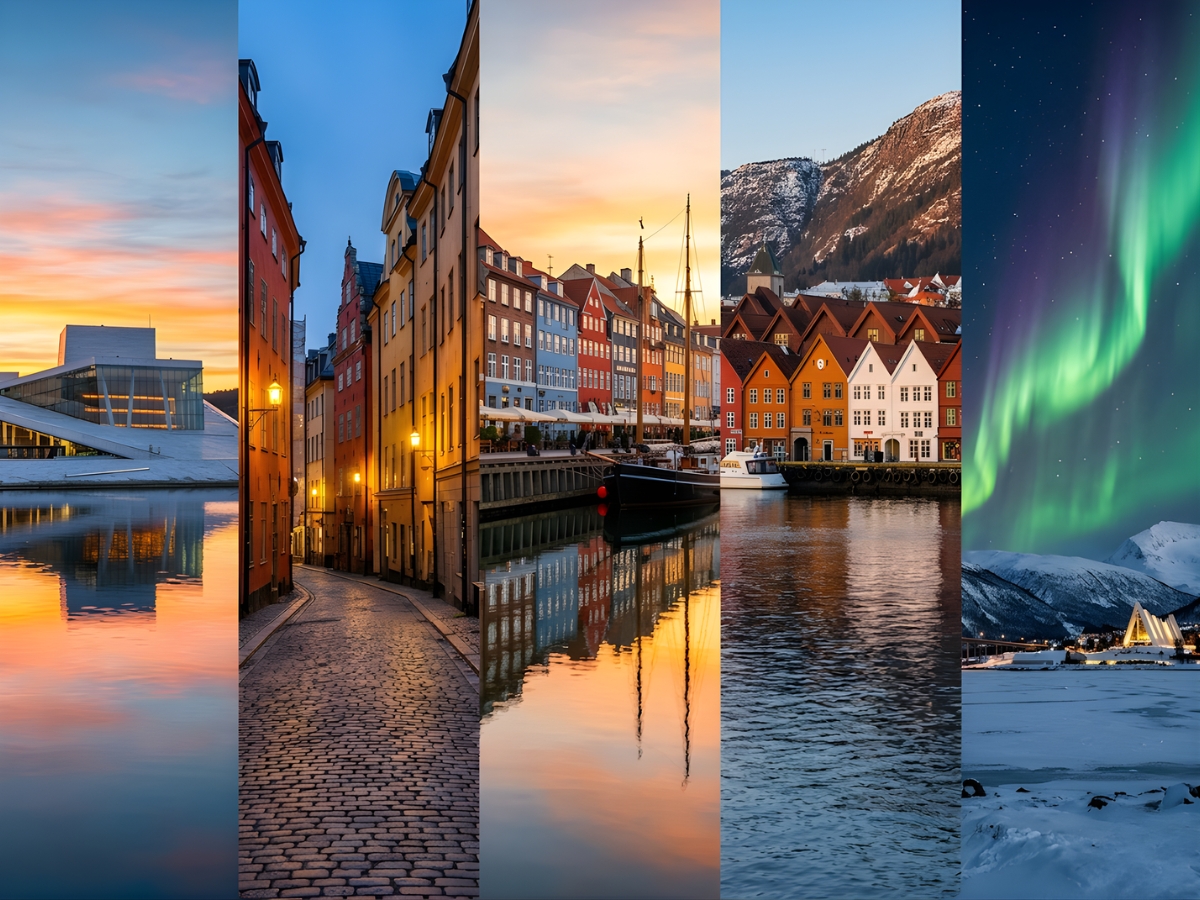
Norway’s capital is compact, walkable, and genuinely impressive. The National Museum houses Edvard Munch’s The Scream alongside one of the world’s great collections of European art. The Vigeland Sculpture Park — 212 sculptures across 80 acres — is free to enter and extraordinary. The Oslo Pass covers unlimited public transport plus free entry to most major museums — essential value for a city with an expensive reputation.
Stockholm, Sweden (ARN)
Built across 14 islands, Stockholm is one of the most beautiful capital cities in Europe. Gamla Stan — the medieval Old Town — is a labyrinth of cobbled streets, amber-lit at dusk, home to the Royal Palace and Stockholm Cathedral. The Vasa Museum (a perfectly preserved 17th-century warship) is world-class. The archipelago — 30,000 islands accessible by public ferry — is extraordinary for budget day trips from the city.
Copenhagen, Denmark (CPH)
The Danish capital rewards slow exploration. Nyhavn canal — brightly coloured 17th-century townhouses reflected in still water — is one of the most recognisable sights in all of Scandinavia. The city is flat and extremely cycle-friendly, with free bike-sharing schemes that make getting around easy and cheap. The National Museum, the Round Tower, and the Church of Our Saviour deliver significant cultural depth at very low cost.
Bergen, Norway (BGO)
Bergen is arguably the most charming city in Scandinavia for its size. The Bryggen Wharf — a row of colourful medieval timber buildings — is a UNESCO World Heritage Site and one of the most photographed streetscapes in Norway. The Fløibanen funicular climbs Mount Fløyen in minutes, delivering panoramic views of the city and surrounding fjords. Bergen is also the primary departure point for fjord cruises including the famous Sognefjord and Nærøyfjord routes.
Helsinki, Finland (HEL)
Technically Nordic rather than strictly Scandinavian, Helsinki is deeply connected to the broader regional identity. The Finnish capital is a design lover’s city — the Design District alone has over 200 shops, studios, and galleries. The Suomenlinna sea fortress (UNESCO World Heritage Site, accessible by public ferry) is one of the best-value half-day trips in any Nordic capital. Helsinki also has excellent overnight ferry connections to Stockholm and Tallinn.
Gothenburg, Sweden (GOT)
Sweden’s second city has a relaxed, maritime character that contrasts pleasantly with Stockholm’s bustle. The Haga district — cobbled streets, wooden houses, and coffee shops — is perfect for slow mornings. The southern archipelago is less visited than Stockholm’s and correspondingly more affordable. Gothenburg is also a major hub for ferries to Denmark and the UK.
Aarhus, Denmark (AAR)
Denmark’s second city is a university town with a youthful energy and exceptional cultural scene. The ARoS Aarhus Art Museum — topped by a rainbow panorama walkway — is one of the most architecturally striking museums in Europe. Aarhus is notably more affordable than Copenhagen and easily reached by train in under two hours.
Tromsø, Norway (TOS)
Tromsø is the Northern Lights capital of the world. Located well above the Arctic Circle, this small Norwegian city offers the best combination of accessibility and aurora-viewing conditions anywhere in the region. In winter, dog sledding, snowshoeing, and reindeer herding are all available within easy reach of the city centre. In summer, the Midnight Sun makes for extraordinary 24-hour daylight.
Odense, Denmark (ODE)
The birthplace of Hans Christian Andersen has a fairy-tale quality to match its most famous resident. The H.C. Andersen Museum — redesigned and reopened in recent years — is one of Denmark’s most imaginative cultural spaces. Odense is significantly more affordable than Copenhagen, with a well-preserved medieval centre and excellent cycling infrastructure.
Turku, Finland (TKU)
Finland’s oldest city sits at the mouth of the Aura River and offers a compelling alternative to Helsinki. Turku Castle dates to the 13th century and is one of the largest surviving medieval castles in the Nordic region. The city is a major hub for ferry connections to Stockholm via the stunning Stockholm archipelago — one of Scandinavia’s great scenic sea journeys.
Cheap Flights to Scandinavia from London
Getting to Scandinavia from London is easier — and cheaper — than most travelers expect. Budget carriers operate direct routes to all three main capitals, with prices starting from £30–60 one-way when booked in advance. Using Google Flights tricks like flexible date searches and price alerts can cut costs significantly on any of these routes.
Best airlines for Scandinavia flights from London
- Norwegian Air — Strong coverage from London Gatwick to Oslo, Stockholm, and Copenhagen. Often the cheapest option.
- easyJet — Excellent routes to Copenhagen and Oslo from multiple London airports.
- SAS (Scandinavian Airlines) — Direct to all three capitals; competitive during sales.
- Ryanair — Routes to Stockholm Skavsta and secondary Scandinavian airports. Very cheap but check transfer times to city centres.
- British Airways — Daily direct services to all three capitals; good for flexible fares.
Scandinavia Budget Breakdown — What to Expect
Scandinavia’s reputation for expense is partly earned — but the gap between perceived and actual cost is significant for those who plan well. Copenhagen is the most affordable capital; Oslo the most expensive. Eating from supermarkets, using city passes, and choosing shoulder-season travel can bring a week-long trip to a genuinely manageable figure.
| Category | Budget | Mid-Range | Notes |
|---|---|---|---|
| ✈ Flights (round-trip from London) | £60–120 | £150–250 | Book 8–12 weeks ahead |
| 🛏 Accommodation (per night) | £25–50 | £90–160 | Hostels and budget hotels |
| 🍜 Food (per day) | £20–35 | £55–90 | Supermarkets + one restaurant meal |
| 🚌 Local transport (per day) | £6–14 | £18–30 | Day passes; cycling free in some cities |
| 🎒 Activities (per day) | £10–20 | £35–70 | Mix of free museums and paid attractions |
| 🛡 Travel insurance (7 days) | £15–30 | £30–60 | Never skip — especially for Norway |
| 7-Day Total (budget) | £550–750 | Copenhagen cheapest; Oslo most expensive |
Budget tips that actually work in Scandinavia
- Supermarkets over restaurants. Lidl, ICA (Sweden), Rema 1000 (Norway/Denmark), and K-Market (Finland) all stock excellent local produce. A packed lunch costs a fraction of café prices.
- City passes. The Oslo Pass, Stockholm Card, and Copenhagen Card include unlimited public transport plus free museum entry — they pay for themselves quickly.
- Overnight trains and ferries. Stockholm–Oslo or Stockholm–Helsinki overnight routes combine transport and accommodation in one cost, saving a night’s hotel.
- Free museum days. Most major national museums offer free entry on at least one day per week or month. Research before you arrive.
For travelers planning longer stays or working remotely, Sweden and Denmark both have fast internet infrastructure and a strong coworking culture, consistently ranking among the best destinations for digital nomads in Europe.
Best Time to Visit Scandinavia
- June–August (Summer) — Midnight Sun, long days, outdoor festivals, hiking season. Peak prices. Best for fjords, cycling, and island-hopping.
- September–October (Early Autumn) — First Northern Lights opportunities. Fewer crowds, lower prices. Spectacular autumn foliage.
- November–February (Winter) — Peak Northern Lights season. Christmas markets in Copenhagen, Stockholm, and Oslo. Snow activities in Lapland. Cold, but genuinely magical.
- March–May (Spring) — Prices drop significantly. Snow still in northern areas. Cities come alive. Best overall value.
Free Things to Do in Scandinavia
Despite its reputation, this region offers a remarkable number of free experiences — many of them among the best it has to offer:
- Free walking tours — Available in all major cities on a tip basis. Find free walking tours in Scandinavia across Oslo, Stockholm, Copenhagen, and Helsinki.
- Vigeland Sculpture Park (Oslo) — 212 sculptures by Gustav Vigeland, free entry, open year-round.
- Gamla Stan (Stockholm) — The medieval Old Town is entirely free to explore.
- Nyhavn (Copenhagen) — The iconic canal costs nothing to walk and photograph.
- Fløyen Mountain (Bergen) — Walk up in 45 minutes for free. Views over Bergen and the surrounding fjords are spectacular.
- Suomenlinna (Helsinki) — The sea fortress is free to enter, accessible on the public ferry for the price of a standard transit ticket.
Essential Scandinavia Travel Tips
- Cards are accepted everywhere. All three countries are almost entirely cashless. You can pay by card in every shop, café, market stall, and museum without exception.
- Tap water is excellent. Safe, clean, and often served free in restaurants. Never buy bottled water — it’s unnecessary expenditure.
- Dress in layers. Weather changes quickly, especially in Norway and on the Swedish coast. Lightweight, packable layers are more practical than heavy outerwear.
- Validate your transport ticket. In Stockholm and some Swedish cities, you must validate your ticket before boarding. Inspectors issue fines even on valid tickets that haven’t been validated.
- Book fjord tours in advance. Popular routes like the Nærøyfjord cruise from Flåm fill months ahead during summer.
- Interrail is worth considering. For multi-country trips lasting 10 days or more, the Interrail Nordic Pass covers trains, many ferries, and some bus routes across all four Nordic countries.
Ready to book your Scandinavia trip?
Search live flight prices to Oslo, Stockholm, Copenhagen and beyond — powered by Aviasales
Search Flights Now →Affiliate disclosure: Some links in this article are affiliate links. If you click through and make a booking, we may earn a small commission at no extra cost to you. This helps keep FlyToAny free and independent. We only recommend services we genuinely use and trust.